What Fabric Geo Zones Changed About Data Sovereignty
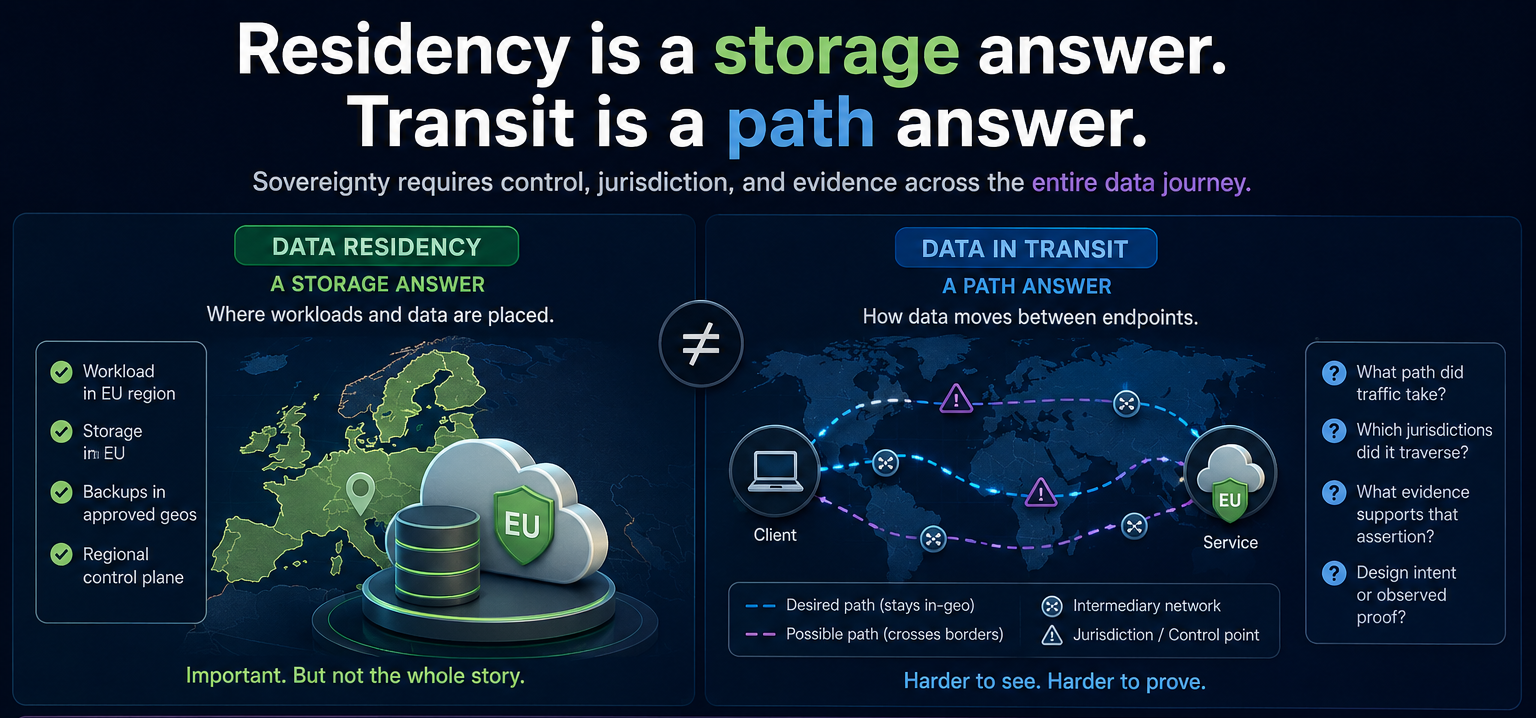
Most sovereignty discussions stay too high in the stack.
They talk about regions, policies, legal requirements, and workload placement.
Those are all real concerns.
But a network has to do something much more concrete.
It has to decide whether a path is valid.
That is what made Equinix Fabric Geo Zones interesting to me.
I served as lead Product Manager for Fabric Geo Zones, and the real product challenge was not creating a new compliance message. It was helping turn geographic intent into operational network behavior.
That is a very different problem.
The Real Technical Question
The interesting question is not "does the customer care about sovereignty?"
Of course they do.
The interesting question is:
How does a network translate a geography requirement into forwarding behavior?
Once you ask it that way, the problem becomes much more tangible.
A sovereignty-aware network service needs to know:
- what geography the customer selected
- which backbone links and metros are eligible for that geography
- which cloud attachment points belong inside that allowed zone
- which failover paths remain compliant
- what to do when performance and geography preferences conflict
That last point matters more than it first appears.
Traditional networking products usually optimize for reachability, resilience, and performance. If a lower-latency path exists, the network generally prefers to use it. If a failure occurs, traffic is rerouted as quickly as possible.
Sovereignty changes the objective function.
Now the network has to ask:
- Is this path still inside the allowed zone?
- Does failover preserve the jurisdictional boundary?
- Should traffic be blocked if the only surviving path exits the zone?
That is not marketing language.
That is control-plane behavior.
From Geography To Eligible Infrastructure
The network needs a mapping between a policy concept and actual infrastructure.
For a sovereign zone to mean anything operationally, the provider has to maintain a model of which network elements are eligible for that zone. That can include metros, interconnection points, transport segments, and cloud-facing attachment locations.
Only after that mapping exists can the service make consistent decisions.
At a high level, the logic looks like this:
- The customer requests a connection associated with a specific sovereign geography.
- The service maps that request to an allowed set of infrastructure elements.
- Path computation considers only eligible transport options.
- If no eligible path exists, the service cannot quietly "do its best" outside policy.
That last step is where the product gets real.
Without it, sovereignty is just preference.
With it, sovereignty becomes a constraint.
Failure Behavior Is The Truth Test
Normal-state demos are easy.
Almost every architecture looks compliant when every preferred link is healthy.
The harder question is what happens during maintenance, congestion, or backbone failure.
That is where sovereignty products either become credible or fall apart.
A useful way to think about it is this:
- normal networking says "keep traffic flowing"
- sovereignty-aware networking says "keep traffic flowing only if policy still holds"
That means some failures should trigger rerouting.
Others should trigger denial.
If the only available alternate path exits the approved geography, blocking may be the correct outcome.
That feels uncomfortable if you are used to availability being the highest priority.
But for regulated environments, an explicitly denied path can be more defensible than a silent policy violation.
This is one of the clearest ways Fabric Geo Zones changed the conversation. It made the tradeoff visible. Compliance was no longer something assumed from topology diagrams. It became something the network either enforced or did not.
Why This Matters For Hybrid Multicloud
The hybrid multicloud case is where this gets more compelling.
Inside a single cloud, customers already depend heavily on provider-defined routing behavior. Once traffic crosses between clouds, SaaS providers, and enterprise environments, the architecture becomes harder to reason about and much harder to explain to risk teams.
That is where private interconnection and constrained transport matter.
A sovereignty-aware interconnection service can contribute a specific piece of value:
- it narrows the set of acceptable paths
- it makes path policy part of the service definition
- it gives customers a cleaner story for cloud-to-cloud and enterprise-to-cloud movement
It does not solve every sovereignty problem.
It does solve a more precise one:
how to reduce the chance that traffic leaves an approved geography while moving between connected environments
That is a useful technical boundary.
AI Workloads Raise The Bar
The Equinix blog post Data Sovereignty vs. Global AI Scale makes an important point: AI infrastructure makes sovereignty harder, not easier.
AI workflows are distributed by design.
Data sources, model services, training systems, inference endpoints, vector stores, observability pipelines, and recovery environments may all sit in different places. Even when the application experience looks simple, the supporting traffic pattern often is not.
That creates a bigger design burden:
- more east-west traffic
- more cross-environment dependencies
- more hidden transit assumptions
- more operational pressure to fail over quickly
In that environment, sovereignty cannot live only in documentation. It has to show up in the way connectivity is designed and constrained.
What Changed For Me
The main lesson for me was that sovereignty gets clearer when you stop treating it as an abstract compliance category and start treating it as a network-admission problem.
Which routes are allowed?
Which routes are disallowed?
What infrastructure belongs inside the boundary?
What should the service do under failure?
Those questions are concrete enough for engineering, product, and customer teams to debate honestly.
That is useful because it replaces hand-waving with design choices.
And that, more than anything, is what I think Fabric Geo Zones changed: it pushed the sovereignty conversation closer to how networks actually behave.